Calciol Production
By Jens Allmer
(Updated: May 7, 2026)Cholecalciferol Production
When our skin is exposed to UVB rays, e.g., during sun exposure, Cholecalciferol aka Calciol is produced from 7-Dehydrocholesterol. In a 1977 publication, PC Beadle estimated that about 160 IU Cholecalciferol could be produced at 40° Latitude when exposing 1 $cm^{2}$ of skin to the sun for the whole day. Dark skin would produce around 70 IU under the same conditions. This information is suboptimal to drive the decision of how to expose oneself to the sun.
We would like to estimate the amount of Cholecalciferol we produce during exposure to the sun for a short period of time (say 30 minutes) and for a certain amount of exposure, say 5,000 $cm^{2}$, which would be legs, arms, and face. We might want to adjust the estimate to our skin type as well. Most importantly, we should have a good estimate of the UVB radiation. For all of this, let’s develop two formulas.
$$IU_{Cholecalciferol}/min \times cm^{2} = 2,500 × E_{daily} / t_{daylight} \tag{1}$$
$E_{daily}$: The daily portion of UV radiation relevant for D3 in kJ/$m^{2}$.
$t_{daylight}$: Total Daylight Time in minutes.
We can find yesterday’s or other past UV doses at TEMIS (a number between 0 and 14). This number should be plugged in for Edaily. Then we need the minutes of daylight which we can find for example at timeanddate. Calculate the minutes and plug it in for tdaylight. That provides us with the IUs of Cholecalciferol that one $cm^{2}$ skin can produce in one minute at the given settings time of year and location.
Next we would be interested in using this rate, adjusting it to the area exposed and the skin type. for this we will use the following formula.
$$ IU_{Total} = t_{exposed} \times I_{Uper} , \text{J}/cm^{2} \times K_{skin} \times A_{exposed} \tag{2}$$
$I_{Uper}$ J/$cm^{2}$: Cholecalciferol (Vitamin D₃) production per joule per cm²
$K_{skin}$: Skin type factor.
$t_{exposed}$: time of exposure to the sun in minutes.
$A_{exposed}$: Area of skin exposed (cm²).
$IU_{Total}$: Total vitamin D₃ produced in IU.
What we can calculate here are rough estimates since UVB radiation is different throughout the day and strongest around noon. So sunbathing at 7 a.m. will probably do you no good in terms of Cholecalciferol production, but at lunchtime, depending on the season and locale, you will get a good amount of IUs. Check out the converter between IUs and mcgs.
! When exposing yourself to the sun, make sure you never get a sunburn !
You can use the calculator below to estimate how much IU you can produce with the sun exposure you get. This does not consider the physiological limits of the production of Cholecalciferol (a topic for another time).
Vitamin D₃ Production Calculator (Using Edaily in kJ/m²)
Production of Calciol/Cholecalciferol in the skin
There are claims that the production of Calciol in the skin is bound by the body (auto-regulation). I.e. no matter how much sun you get, your body will only produce a certain amount of Calciol. This sounds logical, but is it true? Probably yes. However, the explanations I found are not fully convincing. What makes sense is that if Calciol is further irradiated with UV radiation, it will be transformed (and potentially inactivated). One product could be Lumisterol which would not act as vitamin D. There are many other products that can be produced as well. So the explanation goes as follows:
7-Dehydrocholesterol –> Cholecalciferol –> Lumisterol
All this happens in the skin under the influence of UV radiation. The problem is that this is seen in isolation and doesn’t include the bigger picture. This assumes that the body and hands over control to the sun which cannot be right in my opinion. Clearly, hormones must remain under the control of the body and not the sun. How can the production be controled then?
- The first step could be controlled by the amount of 7-Dehydrocholesterol in the skin.
- The second step could be controled by how fast the Calciol is transported out of the skin to the bloodstream.
Both these steps can be regulated by the body and thus keep control over the Calciol levels. Cholesterol is probably too abundant and needed in every cell of the body to keep the membrane fluid so perhaps it is a bad target for control. The second idea, that the transport out of the skin is regulated has some merit. The idea is that Calciol waits in the membran of the cell where it was produced to be picked up by its transporter (Vitamin-D Binding Protein; DBP). Additionally, some Calciol will dissolve in the serum directly and will be taken up by fat cells for long term storage. Obviously, Calciol is not very soluble but some small amounts will find their way into subcutaneous fat cells. Now, the amount of DBP seems very high and could load large amounts of Calciol. On the other hand, the molecule that DBP is more effective to store is Calcifediol. So why doesn’t DBP get saturated with Calciol? Well, it is a numbers game. The available DBP needs to get into proximity of a Calciol that is ready to be picked up and it needs to be empty (not loaded with Calcifediol) to pick up Calciol. The fuller the pool is with Calcifediol, the less empty DBP is available, the less efficient the pick up will be. Mind you, there will still be large amounts of empty DBP present, but the size of the total pool diminished and therefore the chance to incorporate new Calciol diminishes as well. This leads to Calciol staying in the skin cells longer where it gets further converted and eventually degraded. Does this sound reasonable?
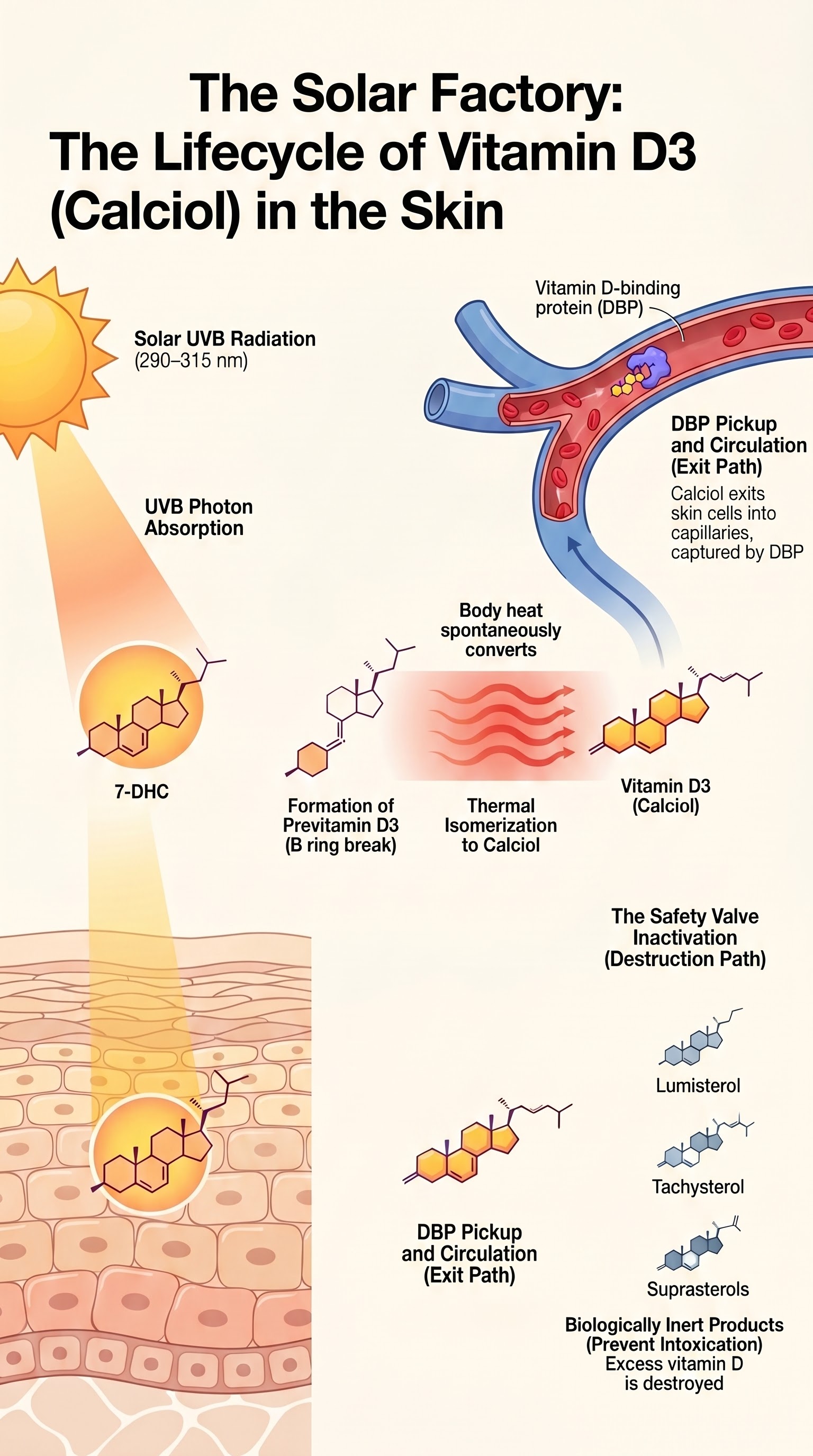 Image was produced with the help of Google’s NotebookLM. Not perfect, for example the Calciol shown in the skin is not positioned in the membrane, but the general idea is conveyed.