Boron
By Jens Allmer
(Updated: October 23, 2026)This makes boron an interesting nutrient-like mineral: we should not treat it like calcium or magnesium, where deficiency syndromes are well established, but we should also not dismiss it as irrelevant.
- Why Boron Might Matter:
- Boron may influence calcium and magnesium handling, vitamin D status, bone formation, inflammatory signaling, and steroid hormone metabolism. These systems are directly or indirectly relevant to bone strength.
- Boron and Bones:
- Low-boron diets in human depletion studies have been associated with increased urinary calcium and magnesium loss, lower serum estrogen in postmenopausal women, and changes in vitamin D and calcium-regulating markers. These changes could plausibly weaken bone metabolism, although direct proof that boron supplementation reliably increases bone mineral density in healthy humans is still limited.
- Daily Requirement:
- There is no official RDA, AI, or EAR for boron. Typical adult intake is roughly around 1.0–1.5 mg/day, especially from plant-rich diets. The WHO has estimated an acceptable safe adult intake range of 1–13 mg/day.
- Too Little Boron:
- A clear human boron-deficiency disease has not been established. However, low-boron intake may affect mineral balance, vitamin D markers, and possibly mental alertness.
- Too Much Boron:
- More is not better. The U.S. adult tolerable upper intake level is 20 mg/day from all sources. EFSA has used a lower adult upper level of 10 mg/day. Toxicity from accidental ingestion of boron-containing cleaning products or pesticides can cause nausea, vomiting, diarrhea, rash, headache, convulsions, and in extreme cases death.
- Sources of Boron:
- Boron is found mainly in fruits, legumes, nuts, vegetables, potatoes, coffee, milk, cider, wine, and beer. Plant foods tend to be the better sources, and boron content can vary with soil and water composition.
In short, boron is not a classical “must-supplement” mineral, but a small dietary intake may support the mineral network that keeps bones strong. It seems most sensible to obtain boron from a plant-rich diet rather than high-dose supplementation.
Elemental Boron
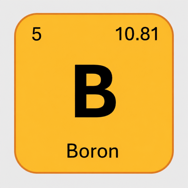
Boron has the atomic number 5, which means it contains 5 protons and 5 electrons. Its atomic weight is about 10.8, reflecting the natural mixture of boron isotopes. Boron is a metalloid, not an alkaline earth metal like calcium and magnesium. In nutrition, we are not dealing with elemental boron as a shiny isolated element, but with boron-containing compounds found in food and supplements.
In foods and beverages, boron occurs mainly as inorganic borates and as sugar-borate esters, including compounds such as calcium fructoborate. After ingestion, much of it is hydrolyzed in the gastrointestinal tract to boric acid, which appears to be the main form circulating in blood and excreted in urine. The body absorbs a high fraction of ingested boron, roughly 85–90%, but the exact intestinal absorption mechanisms are still not well understood.
Boron does not appear to accumulate strongly in most tissues. Bone, hair, and nails tend to contain more boron than many other tissues, while fat contains less. This does not prove that boron is essential for bone, but it is consistent with the idea that boron participates in mineral-rich tissues.
Why Boron Matters
Boron is often discussed together with calcium, magnesium, vitamin D, and bone health. The reason is not that boron forms the bulk structure of bone. Calcium and phosphate, in the form of hydroxyapatite crystals, are the main mineral components that give bone hardness. Magnesium modifies crystal structure and participates in vitamin D and PTH physiology. Vitamin K activates osteocalcin, which helps bind calcium into the bone matrix.
Boron seems to sit at the edge of this network. It may influence how calcium and magnesium are retained, how vitamin D status is maintained, how osteoblast and osteoclast activity is regulated, and how steroid hormones such as estrogen and testosterone behave. These are not small issues for bone. Bone is not a dead mineral stick; it is a living tissue continuously rebuilt by osteoblasts and degraded by osteoclasts.
The problem is that boron’s role is still less firmly defined than that of calcium, magnesium, vitamin D, or vitamin K. Authorities therefore remain cautious. NIH ODS states that boron is not classified as essential for humans because a clear biological function has not yet been identified, while also acknowledging possible beneficial effects on calcium metabolism, bone formation, vitamin D/steroid hormone function, immunity, and brain function.
Daily Requirement
There is no official recommended daily allowance for boron. This is important. With calcium and magnesium, one can talk about recommended daily intake values. With boron, the evidence is not strong enough for a formal RDA, AI, or EAR.
Typical adult intake is often around 1.0–1.5 mg/day. People eating more plant foods tend to get more boron, because fruits, legumes, nuts, and vegetables contain more boron than most animal foods. Vegetarians often have higher boron intakes than non-vegetarians.
The WHO has estimated an acceptable safe intake range of 1–13 mg/day for adults. This should not be misunderstood as a target range for supplementation. It means that normal intakes in that range are expected to be safe. It does not mean that 13 mg is better than 1–3 mg.
A practical interpretation is:
| Intake level | Practical interpretation |
|---|---|
| <0.5 mg/day | Probably low; may occur with very restricted low-plant diets |
| ~1–3 mg/day | Common dietary range; likely enough for most people |
| ~3 mg/day | Often used in studies and supplements |
| 6 mg/day | Sometimes studied for osteoarthritis/inflammation; not necessary for everyone |
| 10 mg/day | Around the EFSA adult upper level |
| 20 mg/day | U.S. adult tolerable upper intake level |
| >20 mg/day | Avoid unless medically supervised |
Boron uptake seems efficient compared with many other minerals. NIH ODS reports that about 85–90% of ingested boron is absorbed. However, unlike calcium and magnesium, the exact transport system is not well characterized.
Most absorbed boron is excreted in urine. Urinary boron levels correlate reasonably well with boron intake, which is one reason urinary boron can be used in research settings as a marker of intake. Boron status is not routinely measured in clinical practice.
This makes boron different from calcium and magnesium in another way. Calcium and magnesium are tightly regulated because they are directly involved in nerve signaling, muscle contraction, heart rhythm, and many enzyme systems. Boron appears to be handled more quietly: absorbed, distributed, and mostly excreted, with possible regulatory effects that are still being investigated.
Boron and Bones
The bone question is the most interesting part.
The conservative answer is: there is scientific evidence that boron affects variables related to bone metabolism, but there is not yet definitive evidence that boron supplementation reliably improves bone mineral density or prevents fractures in humans.
That distinction matters.
A human low-boron diet of about 0.25 mg boron per 2,000 kcal has been reported to increase urinary calcium and magnesium excretion and lower serum estrogen in postmenopausal women. Boron repletion with about 3 mg/day reduced urinary loss of calcium and magnesium in that study. This suggests that small amounts of boron may help the body retain minerals relevant for bone.
Other depletion-repletion studies found that boron depletion could lower plasma ionized calcium and serum 25-hydroxyvitamin D while increasing calcitonin and osteocalcin, especially under low-magnesium or marginal-copper conditions. These are not direct fracture outcomes, but they are biologically relevant because calcium, vitamin D, calcitonin, osteocalcin, magnesium, estrogen, and bone turnover are connected.
However, not all studies agree. A later controlled metabolic-unit study in postmenopausal women found that magnesium deprivation clearly affected mineral metabolism, but dietary boron did not have an obvious effect on the response to magnesium deprivation. This means the boron-bone story is plausible, but not fully settled.
A placebo-controlled trial in young female athletes and sedentary women used 3 mg/day boron for 10 months. It changed some mineral markers, such as serum magnesium and phosphorus, but did not directly improve bone mineral density.
A 2020 narrative review concluded that 3 mg/day boron, alone or with other nutrients, may support bone health through calcium, vitamin D, and sex-steroid metabolism, but the review also noted that the number of eligible studies was limited.
So the strongest honest statement is:
Boron may be needed in small amounts for optimal bone metabolism, especially because it appears to influence calcium, magnesium, vitamin D, and hormone-related pathways. But boron should not be presented as a proven stand-alone osteoporosis treatment.
Why a Small Amount Could Help Strong Bones
Bones require more than calcium. A simplified bone system includes:
calcium + phosphate → hydroxyapatite hardness collagen → flexible scaffold magnesium → mineral structure and vitamin D/PTH interaction vitamin D → calcium absorption and calcium regulation vitamin K → osteocalcin activation boron → possible support of calcium/magnesium retention, vitamin D status, and steroid hormone effects
This is why boron is interesting. It does not need to be present in gram quantities to matter. Trace elements often act through regulation, enzyme interactions, membrane effects, or hormone-related pathways. If boron helps reduce urinary calcium and magnesium loss or supports vitamin D-related metabolism, then even a few milligrams could matter.
The evidence is most consistent with boron being a supporting trace element in the bone-mineral network rather than a major structural bone mineral.
Boron Supplements
Boron supplements exist in several forms, including boron citrate, boron glycinate, boron gluconate, boron aspartate, boron amino acid chelates, sodium borate, sodium tetraborate, and calcium fructoborate. Supplement labels usually list the amount of elemental boron, not the weight of the entire compound. Common supplement doses range from about 0.15 to 6 mg elemental boron.
Unlike magnesium, where different compounds have very different practical absorption and tolerability profiles, there is not enough evidence to say that one boron form is clearly superior. NIH ODS states that data are not available on the relative bioavailability of different supplemental boron forms.
A practical supplement table would therefore be cautious:
| Form | Typical use | Practical interpretation |
|---|---|---|
| Boron citrate | Common supplement form | No strong evidence that it is superior |
| Boron glycinate | Common supplement form | Often marketed as gentle; comparative data limited |
| Boron gluconate | Common supplement form | No clear superiority proven |
| Boron aspartate | Common supplement form | No clear superiority proven |
| Calcium fructoborate | Studied in osteoarthritis/inflammation trials | Interesting but not magic |
| Sodium borate / sodium tetraborate | Used in some research/supplements | Do not confuse with household borax products |
| Boric acid / borax cleaning products | Not a food supplement context | Do not ingest |
This last point is important. Boron in foods and properly manufactured supplements is not the same thing as accidentally swallowing borax, boric acid cleaning products, or pesticides. Those can be toxic.
Boron-Rich Foods
Boron is found mostly in plant foods. Exact values vary because boron content depends on soil, water, and growing conditions. USDA FoodData Central does not routinely list boron content, so boron food tables are less complete than calcium or magnesium tables.
Approximate boron content from NIH ODS:
| Food | Approx. boron per serving |
|---|---|
| Prune juice, 1 cup | 1.43 mg |
| Avocado, ½ cup cubed | 1.07 mg |
| Raisins, 1.5 oz | 0.95 mg |
| Peach, 1 medium | 0.80 mg |
| Grape juice, 1 cup | 0.76 mg |
| Apple, 1 medium | 0.66 mg |
| Pear, 1 medium | 0.50 mg |
| Peanuts, 1 oz | 0.48 mg |
| Refried beans, ½ cup | 0.48 mg |
| Peanut butter, 2 tbsp | 0.46 mg |
| Grapes, ½ cup | 0.37 mg |
| Orange, 1 medium | 0.37 mg |
| Lima beans, ½ cup cooked | 0.35 mg |
| Broccoli, ½ cup cooked | 0.20 mg |
| Spinach, ½ cup cooked | 0.16 mg |
| Banana, 1 medium | 0.16 mg |
| Coffee, 1 cup | 0.07 mg |
| Milk, 1 cup | 0.04 mg |
| Chicken breast, ½ breast |
A diet containing fruits, legumes, nuts, potatoes, vegetables, and coffee can easily reach around 1–3 mg/day without supplementation. A very refined diet low in plant foods will likely provide less.
Boron Imbalances
Low Boron
A clear boron-deficiency disease has not been firmly established in humans. That is why boron is not treated like calcium, magnesium, zinc, iodine, or iron. However, low-boron intake has been associated in small studies with changes in calcium and magnesium excretion, vitamin D markers, estrogen levels, and possibly cognitive performance.
For bone health, the concern is not that low boron immediately causes a dramatic deficiency syndrome. The concern is more subtle: a chronically low-boron diet might slightly worsen the calcium-magnesium-vitamin D-hormone environment needed for optimal bone remodeling.
High Boron
High boron intake can be harmful. Acute toxicity has mostly been described after accidental ingestion of boric acid or borax-containing products. Symptoms can include nausea, vomiting, diarrhea, rash, headache, hypothermia, restlessness, renal injury, dermatitis, hair loss, anorexia, convulsions, and vascular collapse. Extremely high doses can be fatal.
The U.S. adult upper intake level is 20 mg/day. This includes boron from food, beverages, and supplements. For children, the upper limits are much lower: 3 mg/day for ages 1–3, 6 mg/day for ages 4–8, 11 mg/day for ages 9–13, and 17 mg/day for ages 14–18.
Therefore, boron should not be treated as “harmless because it is natural.” A small amount may be useful; a large amount is unnecessary and potentially toxic.
Testing Boron Status
Boron status is not routinely measured in clinical practice. Research studies often use urinary boron because urinary boron correlates reasonably well with intake. Blood boron can also be measured in research contexts, but this is not a standard test for ordinary health assessment.
For bone health, it usually makes more sense to assess the established parts of the system first:
| Concern | More established tests |
|---|---|
| Bone density | DXA scan |
| Calcium regulation | Serum calcium, ionized calcium, albumin |
| Vitamin D status | 25-hydroxyvitamin D |
| Parathyroid axis | PTH |
| Magnesium status | Serum magnesium, possibly urinary magnesium in selected cases |
| Bone turnover | Osteocalcin, P1NP, CTX, alkaline phosphatase depending on context |
| Kidney handling | Creatinine/eGFR, urinary calcium when indicated |
Boron may be part of the picture, but it is not usually the first clinical measurement to request.
Boron and Vitamin D
Boron is often discussed as a possible vitamin D helper. Some low-boron studies reported lower serum 25-hydroxyvitamin D during boron depletion, and a small study in vitamin-D-deficient men reported that 6 mg/day boron for 60 days increased serum 25-hydroxyvitamin D by about 20%.
This does not mean boron replaces vitamin D. It also does not mean boron alone solves bone health. A better interpretation is that boron may influence vitamin D metabolism or stability in some contexts. If true, this would help explain why boron affects bone-related outcomes indirectly.
Boron and Hormones
Several studies suggest that boron can influence steroid hormones, including estrogen and testosterone. In postmenopausal women, boron supplementation after a low-boron diet increased serum 17β-estradiol and testosterone in early studies. Health Canada’s review notes that boron may both enhance and mimic some effects of estrogen in certain contexts, although not all outcomes were beneficial or consistent.
This matters for bone because estrogen strongly affects bone turnover. After menopause, declining estrogen increases bone resorption and contributes to osteoporosis risk. If boron modestly influences estrogen-related pathways, that could be one mechanism by which boron affects bone.
However, this is also a reason not to take high-dose boron casually. Hormone-related effects can be biologically meaningful, but they are not automatically desirable for every person.
Practical Recommendation
For most people, the best boron strategy is simple:
Eat enough plant foods.
A diet containing fruits, legumes, nuts, potatoes, vegetables, and perhaps coffee or tea likely provides a reasonable boron intake. There is no need to chase high doses.
A small supplement dose around 1–3 mg/day may be reasonable for people who deliberately want to ensure boron intake, especially if their diet is low in plant foods. The 3 mg/day dose is also common in the bone-health literature. However, boron supplementation should not be presented as a proven osteoporosis treatment, and high-dose supplementation should be avoided.